

How To Uninstall Mysql Windows
In MySQL for Visual Studio version 1.2.4 and earlier, there was an issue, existing merely under a specific scenario, which was preventing the plugin to exist uninstalled (either using the "Remove" option in the Windows Control Panel/Programs, or the MySQL Installer for Windows) or upgraded to a newer version, causing the uninstall/update action to be rolled dorsum during the process. (For further information about this issue delight refer to http://bugs.mysql.com/bug.php?id=71226).
Such scenario can be achieved as follows:
- First install Visual Studio 2012, or VS 2013 or VS 2015
- Then, install MySQL for Visual Studio version 1.2.4 or before
- Later, uninstall Visual Studio 2012, or VS2013 or VS2015
With the scenario described above, the uninstall/upgrade process of the MySQL for Visual Studio plugin is aborted, leaving it installed on the computer.
Information technology is of import to mention that this consequence was already fixed in MySQL for Visual Studio 1.2.five or later, so we encourage you to download and install the latest version available. You can choose to upgrade via the MySQL Installer for Windows, or running the MySQL for Visual Studio standalone installer that you lot can download here: http://dev.mysql.com/downloads/windows/visualstudio.
Anyway, if yous simply want to uninstall the MySQL for Visual Studio plugin, and have the scenario described above, you can follow the next steps:
i. Manually create the missing registry values and files needed for the uninstall process of the MySQL for Visual Studio plugin:
a) Create (if non exists) the post-obit registry hive:
* If you lot had VS 2012 when the MySQL for Visual Studio plugin was installed:
– For 32-flake Os:
HKLM:\Software\Microsoft\VisualStudio\11.0\Setup\VS
Having the key "EnvironmentDirectory" with the value "C:\Program Files\Microsoft Visual Studio 11.0\Common7\IDE\"
– For 64-fleck Os:
HKLM:\Software\Wow6432Node\Microsoft\VisualStudio\xi.0\Setup\VS
Having the key "EnvironmentDirectory" with the value "C:\Program Files (x86)\Microsoft Visual Studio 11.0\Common7\IDE\"
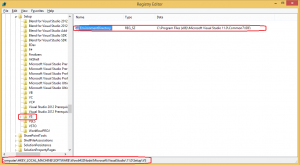
(Figure one: Registry key needed for Visual Studio 2012)
* If you had VS 2013 when the MySQL for Visual Studio plugin was installed:
– For 32-fleck OS:
HKLM:\Software\Microsoft\VisualStudio\12.0
Having the key "ShellFolder" with the value "C:\Program Files\Microsoft Visual Studio 12.0\"
– For 64-flake OS
HKLM:\Software\Wow6432Node\Microsoft\VisualStudio\12.0
Having the key "ShellFolder" with the value "C:\Programme Files (x86)\Microsoft Visual Studio 12.0\"
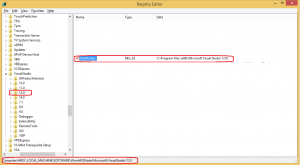
(Figure 2: Registry key needed for Visual Studio 2013)
* If you had VS 2015 when the MySQL for Visual Studio plugin was installed:
– For 32-bit OS:
HKLM:\Software\Microsoft\VisualStudio\xiv.0
Having the cardinal "ShellFolder" with the value "C:\Program Files\Microsoft Visual Studio 14.0\"
– For 64-bit OS
HKLM:\Software\Wow6432Node\Microsoft\VisualStudio\fourteen.0
Having the key "ShellFolder" with the value "C:\Plan Files (x86)\Microsoft Visual Studio 14.0\"
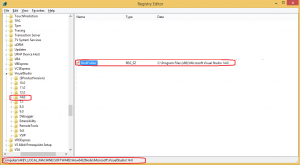
(Figure 3: Registry key needed for Visual Studio 2015)
b) Create (if not exists) an empty file named "extensions.configurationchanged", in the following path:
* If you had VS 2012 when the MySQL for Visual Studio plugin was installed:
– For 32-chip Bone:
C:\Program Files\Microsoft Visual Studio eleven.0\Common7\IDE\Extensions\
– For 64-bit Bone
C:\Program Files (x86)\Microsoft Visual Studio 11.0\Common7\IDE\Extensions\
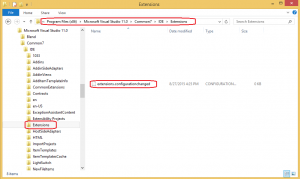
(Figure 4: File needed for Visual Studio 2012)
* If you had VS 2013 when the MySQL for Visual Studio plugin was installed:
– For 32-bit Os:
C:\Program Files\Microsoft Visual Studio 12.0\Common7\IDE\Extensions\
– For 64-bit Os
C:\Program Files (x86)\Microsoft Visual Studio 12.0\Common7\IDE\Extensions\
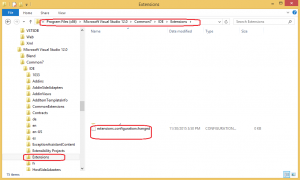
(Figure five: File needed for Visual Studio 2013)
* If you had VS 2015 when the MySQL for Visual Studio plugin was installed:
– For 32-scrap Bone:
C:\Programme Files\Microsoft Visual Studio 14.0\Common7\IDE\Extensions\
– For 64-scrap OS
C:\Program Files (x86)\Microsoft Visual Studio fourteen.0\Common7\IDE\Extensions\
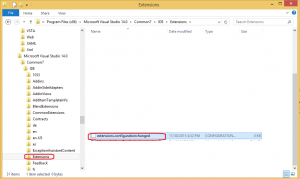
(Effigy 6: File needed for Visual Studio 2015)
c) Proceed to uninstall the MySQL for Visual Studio plugin, using the "Remove" option in the Windows Command Panel/Programs, or executing the plugin installer (version 1.two.4 or earlier).
2. Create and execute two PowerShell scripts to automate the procedure mentioned in step one, performing the adjacent operations:
a) Using a text editor, create a new text file
b) Re-create the post-obit script into the file:
function Test-RegistryValue { param( [Alias("PSPath")] [Parameter(Position = 0, Mandatory = $true, ValueFromPipeline = $truthful, ValueFromPipelineByPropertyName = $true)] [String]$Path , [Parameter(Position = 1, Mandatory = $truthful)] [Cord]$Name , [Switch]$PassThru ) process { if (Test-Path $Path) { $Key = Get-Item -LiteralPath $Path if ($Fundamental.GetValue($Name, $nothing) -ne $null) { if ($PassThru) { Get-ItemProperty $Path $Name } else { $true } } else { $false } } else { $simulated } } } part ValidateRegistryAndExtensionsFile($vsVersion, $pluginRegistryPath, $pluginRegistryName, $vsRegistryPath, $vsRegistryName, $vsRegistryValue, $extensionsFilePath) { echo $("`north`due north -- Check whether the M4VS plugin is installed for VS" + $vsVersion + ".") if (Test-RegistryValue -Path $pluginRegistryPath -Name $pluginRegistryName) { echo $("> The script detected that the M4VS plugin is installed for VS" + $vsVersion + ". Checking if registry key needs to be created.") if (!(Exam-RegistryValue -Path $vsRegistryPath -Name $vsRegistryName)) { echo $("> The registry fundamental doesn't exists for VS" + $vsVersion + ". The script volition create it.") New-Particular -Path $vsRegistryPath -Force New-ItemProperty -Path $vsRegistryPath -Name $vsRegistryName -Value $vsRegistryValue -PropertyType Cord -Force ### Write in the registry that nosotros take created the registry fundamental New-ItemProperty -Path "hkcu:\Console" -Name $("M4VSUninstall_RegKey_" + $vsVersion) -Value "1" -PropertyType String -Force echo $("-- Check whether the extensions file exists for VS" + $vsVersion + ".") if (!(Test-Path $extensionsFilePath)) { echo $("> The extensions file doesn't exists for VS" + $vsVersion + ". The script will create it.") New-Particular $extensionsFilePath -type file -force ### Write in the registry that we have created the file New-ItemProperty -Path "hkcu:\Console" -Proper name $("M4VSUninstall_ExtFile_" + $vsVersion) -Value "1" -PropertyType String -Force } else { echo $("> The extensions file already exists for VS" + $vsVersion + ".") } } else { echo $("> The registry cardinal for VS" + $vsVersion + " already exists.") } } else { echo $("> The script detected that the M4VS plugin is Non installed for VS" + $vsVersion + ".") } } role Is64BitsOS() { $version = (Get-WMIObject win32_operatingsystem).OSArchitecture if ($version.Contains("64")) { render $true; } return $false; } $pluginRegistryPath = "hklm:\SOFTWARE\Microsoft\Windows\CurrentVersion\Installer\Folders" ###### VS 2012 ###### $pluginRegistryName = if (!(Is64BitsOS)) {"C:\Program Files\Microsoft Visual Studio eleven.0\Common7\IDE\Extensions\Oracle\MySQL for Visual Studio\"} else {"C:\Plan Files (x86)\Microsoft Visual Studio 11.0\Common7\IDE\Extensions\Oracle\MySQL for Visual Studio\"} $vsRegistryPath = if (!(Is64BitsOS)) {"HKLM:\Software\Microsoft\VisualStudio\11.0\Setup\VS"} else {"HKLM:\Software\Wow6432Node\Microsoft\VisualStudio\eleven.0\Setup\VS"} $vsRegistryName = "EnvironmentDirectory" $vsRegistryValue = if (!(Is64BitsOS)) {"C:\Program Files\Microsoft Visual Studio 11.0\Common7\IDE\"} else { "C:\Program Files (x86)\Microsoft Visual Studio 11.0\Common7\IDE\"} $extensionsFilePath = if (!(Is64BitsOS)) {"C:\Program Files\Microsoft Visual Studio xi.0\Common7\IDE\Extensions\extensions.configurationchanged"} else {"C:\Program Files (x86)\Microsoft Visual Studio xi.0\Common7\IDE\Extensions\extensions.configurationchanged"} ValidateRegistryAndExtensionsFile -vsVersion "2012" ` -pluginRegistryPath $pluginRegistryPath ` -pluginRegistryName $pluginRegistryName ` -vsRegistryPath $vsRegistryPath ` -vsRegistryName $vsRegistryName ` -vsRegistryValue $vsRegistryValue ` -extensionsFilePath $extensionsFilePath ###### VS 2013 ###### $pluginRegistryName = if (!(Is64BitsOS)) {"C:\Program Files\Microsoft Visual Studio 12.0\Common7\IDE\Extensions\Oracle\MySQL for Visual Studio\"} else {"C:\Program Files (x86)\Microsoft Visual Studio 12.0\Common7\IDE\Extensions\Oracle\MySQL for Visual Studio\"} $vsRegistryPath = if (!(Is64BitsOS)) {"HKLM:\Software\Microsoft\VisualStudio\12.0\"} else {"HKLM:\Software\Wow6432Node\Microsoft\VisualStudio\12.0\"} $vsRegistryName = "ShellFolder" $vsRegistryValue = if (!(Is64BitsOS)) {"C:\Programme Files\Microsoft Visual Studio 12.0\"} else { "C:\Programme Files (x86)\Microsoft Visual Studio 12.0\"} $extensionsFilePath = if (!(Is64BitsOS)) {"C:\Program Files \Microsoft Visual Studio 12.0\Common7\IDE\Extensions\extensions.configurationchanged"} else {"C:\Programme Files (x86)\Microsoft Visual Studio 12.0\Common7\IDE\Extensions\extensions.configurationchanged"} ValidateRegistryAndExtensionsFile -vsVersion "2013" ` -pluginRegistryPath $pluginRegistryPath ` -pluginRegistryName $pluginRegistryName ` -vsRegistryPath $vsRegistryPath ` -vsRegistryName $vsRegistryName ` -vsRegistryValue $vsRegistryValue ` -extensionsFilePath $extensionsFilePath ###### VS 2015 ###### $pluginRegistryName = if (!(Is64BitsOS)) {"C:\Program Files\Microsoft Visual Studio xiv.0\Common7\IDE\Extensions\Oracle\MySQL for Visual Studio\"} else {"C:\Program Files (x86)\Microsoft Visual Studio fourteen.0\Common7\IDE\Extensions\Oracle\MySQL for Visual Studio\"} $vsRegistryPath = if (!(Is64BitsOS)) {"HKLM:\Software\Microsoft\VisualStudio\xiv.0\"} else {"HKLM:\Software\Wow6432Node\Microsoft\VisualStudio\14.0\"} $vsRegistryName = "ShellFolder" $vsRegistryValue = if (!(Is64BitsOS)) {"C:\Programme Files\Microsoft Visual Studio 14.0\"} else { "C:\Program Files (x86)\Microsoft Visual Studio fourteen.0\"} $extensionsFilePath = if (!(Is64BitsOS)) {"C:\Program Files \Microsoft Visual Studio fourteen.0\Common7\IDE\Extensions\extensions.configurationchanged"} else {"C:\Plan Files (x86)\Microsoft Visual Studio fourteen.0\Common7\IDE\Extensions\extensions.configurationchanged"} ValidateRegistryAndExtensionsFile -vsVersion "2015" ` -pluginRegistryPath $pluginRegistryPath ` -pluginRegistryName $pluginRegistryName ` -vsRegistryPath $vsRegistryPath ` -vsRegistryName $vsRegistryName ` -vsRegistryValue $vsRegistryValue ` -extensionsFilePath $extensionsFilePath Note: This script is provided every bit a convenience to you equally-is, without any express or implied warranties of whatsoever kind. Its intention is to automate the process of create the registry values and files needed past the MySQL for Visual Studio plugin uninstall process. Oracle is not liable for any issues arising out of your use of the script.
c) Save the file equally "M4VSUninstall_Validation.ps1". Verify the file extension is ".ps1" (selecting the option "All Files" from the drop-down listing in the "Save equally type" option), so the same is non saved as text, merely as a valid PowerShell file. Save it to a valid path, like "C:\Temp".
d) Following the same steps explained above, create a second ".ps1" file, with the following script:
function Examination-RegistryValue { param( [Allonym("PSPath")] [Parameter(Position = 0, Mandatory = $true, ValueFromPipeline = $true, ValueFromPipelineByPropertyName = $truthful)] [String]$Path , [Parameter(Position = 1, Mandatory = $true)] [String]$Name , [Switch]$PassThru ) process { if (Test-Path $Path) { $Primal = Get-Detail -LiteralPath $Path if ($Cardinal.GetValue($Name, $naught) -ne $cypher) { if ($PassThru) { Become-ItemProperty $Path $Name } else { $truthful } } else { $false } } else { $fake } } } function DeleteRegistryAndExtensionsFile($vsVersion, $vsRegistryPath, $vsRegistryName, $extensionsFilePath) { ### Delete the created registry entry, if applies if (Test-RegistryValue -Path "hkcu:\Console" -Name $("M4VSUninstall_RegKey_" + $vsVersion)) { if ((Exam-RegistryValue -Path $vsRegistryPath -Name $vsRegistryName)) { echo $("`n`northward -- Deleting the VS registry path for VS" + $vsVersion + ".") Remove-ItemProperty -Path $vsRegistryPath -Name $vsRegistryName -Force } Remove-ItemProperty -Path "hkcu:\Console" -Name $("M4VSUninstall_RegKey_" + $vsVersion) -Force } ### Delete the created extensions file, if applies if (Test-RegistryValue -Path "hkcu:\Console" -Name $("M4VSUninstall_ExtFile_" + $vsVersion)) { if ((Test-Path $extensionsFilePath)) { echo $("`northward`northward -- Deleting the extensions file for VS" + $vsVersion + ".") Remove-Item $extensionsFilePath -force Remove-ItemProperty -Path "hkcu:\Panel" -Name $("M4VSUninstall_ExtFile_" + $vsVersion) } } } function Is64BitsOS() { $version = (Get-WMIObject win32_operatingsystem).OSArchitecture if ($version.Contains("64")) { return $true; } return $faux; } ###### VS 2012 ###### $vsRegistryPath = if (!(Is64BitsOS)) {"HKLM:\Software\Microsoft\VisualStudio\eleven.0\Setup\VS"} else {"HKLM:\Software\Wow6432Node\Microsoft\VisualStudio\11.0\Setup\VS"} $vsRegistryName = "EnvironmentDirectory" $extensionsFilePath = if (!(Is64BitsOS)) {"C:\Program Files\Microsoft Visual Studio xi.0\Common7\IDE\Extensions\extensions.configurationchanged"} else {"C:\Programme Files (x86)\Microsoft Visual Studio 11.0\Common7\IDE\Extensions\extensions.configurationchanged"} DeleteRegistryAndExtensionsFile -vsVersion "2012" ` -vsRegistryPath $vsRegistryPath ` -vsRegistryName $vsRegistryName ` -extensionsFilePath $extensionsFilePath ###### VS 2013 ###### $vsRegistryPath = if (!(Is64BitsOS)) {"HKLM:\Software\Microsoft\VisualStudio\12.0\"} else {"HKLM:\Software\Wow6432Node\Microsoft\VisualStudio\12.0\"} $vsRegistryName = "ShellFolder" $extensionsFilePath = if (!(Is64BitsOS)) {"C:\Plan Files \Microsoft Visual Studio 12.0\Common7\IDE\Extensions\extensions.configurationchanged"} else {"C:\Program Files (x86)\Microsoft Visual Studio 12.0\Common7\IDE\Extensions\extensions.configurationchanged"} DeleteRegistryAndExtensionsFile -vsVersion "2013" ` -vsRegistryPath $vsRegistryPath ` -vsRegistryName $vsRegistryName ` -extensionsFilePath $extensionsFilePath ###### VS 2015 ###### $vsRegistryPath = if (!(Is64BitsOS)) {"HKLM:\Software\Microsoft\VisualStudio\14.0\"} else {"HKLM:\Software\Wow6432Node\Microsoft\VisualStudio\14.0\"} $vsRegistryName = "ShellFolder" $extensionsFilePath = if (!(Is64BitsOS)) {"C:\Program Files \Microsoft Visual Studio 14.0\Common7\IDE\Extensions\extensions.configurationchanged"} else {"C:\Program Files (x86)\Microsoft Visual Studio xiv.0\Common7\IDE\Extensions\extensions.configurationchanged"} DeleteRegistryAndExtensionsFile -vsVersion "2015" ` -vsRegistryPath $vsRegistryPath ` -vsRegistryName $vsRegistryName ` -extensionsFilePath $extensionsFilePath Note: This script is provided every bit a convenience to you equally-is, without any express or implied warranties of any kind. Its intention is to automate the cleanup operations once the registry values and files needed by the MySQL for Visual Studio plugin uninstall procedure has been created. Oracle is not liable for whatsoever bug arising out of your use of the script.
Salve the file as "M4VSUninstall_PostValidation.ps1" in the same path, validating information technology is saved as a PowerShell file.
east) Open a PowerShell command window, and become to the path where you saved the scripts (like "C:\Temp")
cd c:\Temp
f) Execute the post-obit control:
powershell.exe -ExecutionPolicy Featherbed .\M4VSUninstall_Validation.ps1
one thousand) Uninstall the MySQL for Visual Studio plugin.
h) Execute the following command:
powershell.exe -ExecutionPolicy ByPass .\M4VSUninstall_PostValidation.ps1
in club to cleanup any registry/files created by the scripts, and needed past the uninstall process.
With this workaround, you should be able to uninstall MySQL for Visual Studio 1.ii.iv and earlier.
Thank yous all for your support, and go along enjoying MySQL for Visual Studio.

How To Uninstall Mysql Windows,
Source: https://dev.mysql.com/blog-archive/mysql-for-visual-studio-uninstall-workaround/
Posted by: jaimeoligh1990.blogspot.com
0 Response to "How To Uninstall Mysql Windows"
Post a Comment